Choosing the right orthodontist shapes your family’s smiles for years to come. Whether you’re looking for care for a seven-year-old, a self-conscious teen or yourself, the decision deserves careful thought. This guide covers how to choose a family orthodontist, with practical steps and the questions worth asking before you commit to treatment, for families in Birmingham, Pell City and beyond.
At Feagin Family Orthodontics, we treat patients of every age, so we see firsthand what families look for in a practice. Here’s what matters when you compare offices, which training counts and how to tell a true specialist from someone offering similar-sounding services.
What Is a Family Orthodontist?
A family orthodontist is a dental specialist who completed two to three years of residency training after dental school to focus on tooth movement, bite correction and jaw alignment. Unlike a general or pediatric dentist, an orthodontist treats children, teens and adults under one roof, which makes it easier for families to coordinate care.
General dentists handle cleanings, fillings and overall oral health. Pediatric dentists focus on children’s dental care through adolescence. Orthodontists put their advanced training toward diagnosing and correcting alignment and bite problems with braces, clear aligners and other appliances.
The most important thing to look for is an accredited orthodontic residency on top of a dental degree. That extra training is what separates an orthodontist from a dentist who offers some teeth straightening on the side.
Choosing a true specialist also means continuity. One practice can see your seven-year-old for an early evaluation, treat your teen with braces and later help you straighten your own smile with clear aligners.
How to Evaluate and Choose the Right Orthodontist
Finding the right fit takes a little homework. These six steps will help you make a confident decision for everyone in your household.
- Verify training. Confirm the orthodontist holds a DDS or DMD degree and completed an accredited orthodontic residency. That combination is what separates specialists from general dentists offering aligner services.
- Review the treatment options offered. A well-rounded practice should offer traditional metal braces, clear braces, clear aligners, early treatment for children and retainers after treatment. More options mean a plan that fits each family member instead of a one-size-fits-all approach.
- Schedule a consultation and tour the office. Walking through a practice tells you a lot. Is it clean? Is the team friendly? Do they explain things clearly? A first visit gives you a feel for the place before you commit to anything.
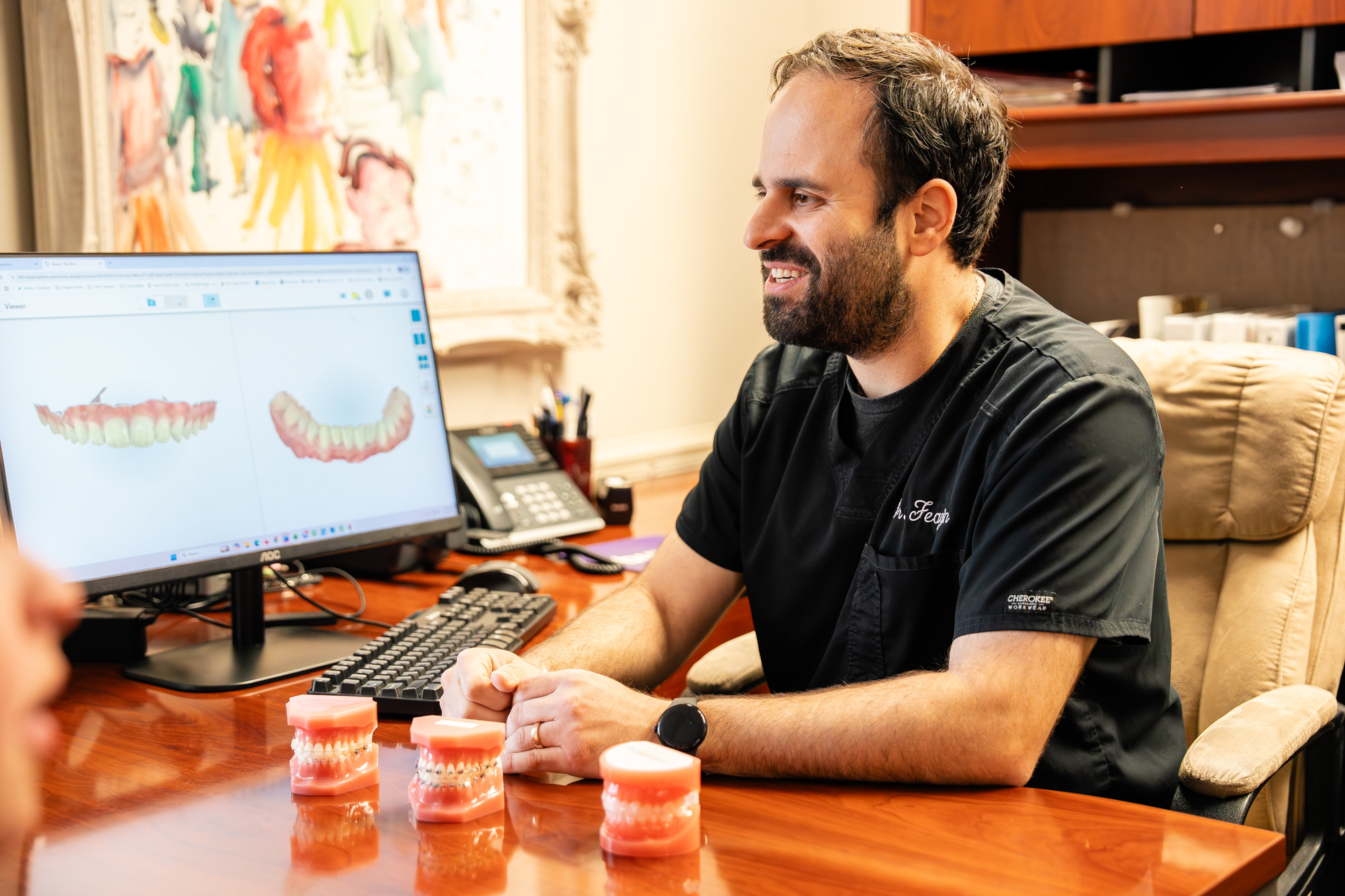
- Ask about technology. Modern tools like digital scans and digital X-rays make visits more comfortable and planning more precise. Ask what the practice uses and how it helps your treatment.
- Confirm scheduling, communication and family logistics. Can appointments fit around school and work? Are the hours convenient? Does the office send reminders? Small details matter when you’re coordinating care for more than one person.
- Get your treatment plan in writing. Any orthodontist you consider should give you a written treatment plan and walk you through it. Ask about insurance and payment plans too, and keep asking questions until everything makes sense.
Questions to Ask at Your Consultation
Bring a short list with you. The answers tell you a lot about how a practice works.
- What problem do you see, and what happens if we wait?
- Which treatment options would work for this case, and why do you recommend one over the others?
- How often will we need appointments?
- Who will we see at each visit?
- What happens after braces or aligners come off?
- Who do we call if a bracket breaks or a retainer gets lost?
Benefits of Choosing a Qualified Family Orthodontist
Picking a specialist practice offers advantages that go well beyond straight teeth.
Why Choose One Practice for the Whole Family?
From your youngest child’s first orthodontic evaluation to your own adult treatment, everyone sees the same trusted team. Records stay in one place. Appointments can often be scheduled together, which cuts down on driving and simplifies the week for busy parents. A family-focused practice also understands what each age group needs, from growing jaws in children to lifestyle-friendly options for adults.
What Does Specialist-Level Diagnosis Mean for Your Smile?
Orthodontists are trained to spot problems that can be easy to miss, including subtle bite issues, jaw development concerns and airway problems that affect sleep. A specialist looks at the whole picture, not just the teeth, and that broader view leads to more accurate plans.
When Is Early Intervention Most Valuable?
The American Association of Orthodontists recommends every child have an orthodontic evaluation by age 7. Catching problems like crossbites, severe crowding or jaw growth concerns early often means simpler treatment later.
How Does Modern Technology Improve Your Experience?
Digital scans replace messy impressions. Advanced imaging allows precise treatment planning. Together, these tools make visits more comfortable and help your orthodontist plan each step with confidence.
Why Does a Consistent Relationship Matter Long-Term?
Orthodontic care doesn’t end when braces come off. Wearing a retainer is critical, and having the same team keep an eye on your smile protects the results you worked for. A practice close to home makes check-ins and retainer adjustments easy to fit into your week. If a wire comes loose or a retainer breaks, you’re not driving hours to get it fixed.
Family Orthodontist vs. General Dentist vs. Mail-Order Aligners
Not all teeth straightening options are created equal. Knowing the differences helps you make a safer choice for yourself and your children.
| Factor | Family Orthodontist | General Dentist | Mail-Order Aligners |
|---|---|---|---|
| Training | 2-3 year accredited orthodontic residency | Dental school only | No in-person provider |
| In-Person Exam | Yes, with full diagnostics | Yes, limited scope | No |
| X-Rays & 3D Imaging | Standard practice | Sometimes | Rarely included |
| Treatment Monitoring | Regular in-office visits | Occasional check-ins | Self-monitored |
| Emergency Support | Available locally | Limited | None |
| Complex Case Capability | Full scope | Limited | Not suitable |
Orthodontists complete years of specialized training beyond dental school. That training covers how teeth move, how jaws grow and how bite forces interact over time. A general dentist may offer clear aligners, but without the same depth of orthodontic diagnosis.
Mail-order aligner companies skip the in-person exam. There are no X-rays to check root health, no hands-on look at your bite and no one watching your progress if something goes wrong. Teeth that move without supervision can lead to bite and gum problems that take more work to fix later.
In-office treatment means someone is watching your progress, adjusting as needed and ready to help if an emergency comes up.
When Is It Time to See a Family Orthodontist?
Every child should have a first orthodontic evaluation by age 7. That visit doesn’t always mean treatment starts right away, but it sets a baseline and catches problems early when they’re easiest to address. You also don’t need a referral from your dentist to book.
Here are common signs it’s time to schedule a consultation.
In children
- Early or late loss of baby teeth
- Crowded, crooked or misplaced teeth
- Difficulty chewing or biting
- Mouth breathing or snoring
- Thumb-sucking past age 5
- Jaws that shift or make sounds
- Teeth that don’t meet properly or don’t meet at all
In teens
- Noticeable crowding or spacing as adult teeth come in
- Bite problems becoming more obvious
- The teen years are the most common time for braces or clear aligners
In adults
- Teeth that have shifted after years without a retainer
- Crowding or gaps that have always bothered you
- Preparing for restorative dental work
It’s never too late to straighten your smile, and clear aligners and clear braces give adults discreet options. A consultation is the best way to find out what’s right for you or your child.
Frequently Asked Questions
How do you pick the right orthodontist?
Start by confirming the orthodontist has a DDS or DMD and completed an accredited orthodontic residency. Then schedule a consultation to meet the team, see the office and talk through a treatment plan. The right orthodontist pairs strong training and modern technology with clear communication and a team your family feels comfortable with.
At what age should my child first see an orthodontist?
The American Association of Orthodontists recommends a first orthodontic evaluation by age 7. By then, enough permanent teeth have come in to spot developing issues like crowding, crossbites or jaw growth concerns. An early evaluation doesn’t always mean early treatment, but it lets us watch and step in at the right time.
Do I need a referral to see an orthodontist?
No. You can book a consultation with an orthodontist directly, without a referral from your dentist.
Can adults see a family orthodontist?
Yes. A family orthodontist treats patients of every age, including adults. Many adults straighten their teeth with clear aligners or clear braces, and some come in after their teeth shifted from not wearing a retainer.
How long does orthodontic treatment take?
It depends on the case, the patient’s age and the type of treatment. Simple spacing or alignment problems usually finish sooner than complex bite correction. Your orthodontist will give you an estimated timeline at your consultation.
Visit Our Birmingham and Pell City Offices
Dr. Kyle Feagin is a Birmingham native who earned his dental degree at UAB and completed his orthodontic residency and master’s degree there, serving as chief resident in his final year. At Feagin Family Orthodontics, he treats children, teens and adults at our Birmingham office in Homewood at 3045 Independence Dr., Homewood, AL 35209 and our Pell City office at 2503 Stemley Bridge Rd., Pell City, AL 35128. Call (205) 871-5557 or schedule a consultation online to meet Dr. Feagin and our team.