Plenty of adults in Homewood and Pell City have thought about straightening their teeth for years without ever booking the appointment. Usually it is not the treatment holding them back. It is the assumption that orthodontics is something you do at fourteen and that the window has quietly closed.
It has not. Teeth respond to steady pressure at any age, and clear aligners for adults have made the whole thing far easier to fit around a job, a family and a normal social life. Here is what treatment actually involves when you are doing it as an adult.
Why Adults Come In
Two stories account for most adult patients.
The first is relapse. You had braces as a teenager, you wore the retainer faithfully for a while, and then life happened. Teeth drift. A little crowding on the lower front teeth is the most common version, and it tends to show up in photographs before it shows up in the mirror.
The second is the person who never had treatment at all. Maybe it was not an option growing up, maybe the timing never worked. Then a video call or a wedding photo puts the issue front and centre and it stops being something to think about later.
Either way, the fix is usually more straightforward than people expect.
Does Age Change Anything?
Clinically, less than you would think. Teeth move through bone the same way at forty as they do at fourteen.
What does change is that growth has finished. In a child, some bite problems can be corrected by guiding the jaws while they are still developing. In an adult, that option is off the table, so certain skeletal issues need a different approach. Straightforward crowding, spacing and mild to moderate bite correction are all well within what aligners handle in adults.
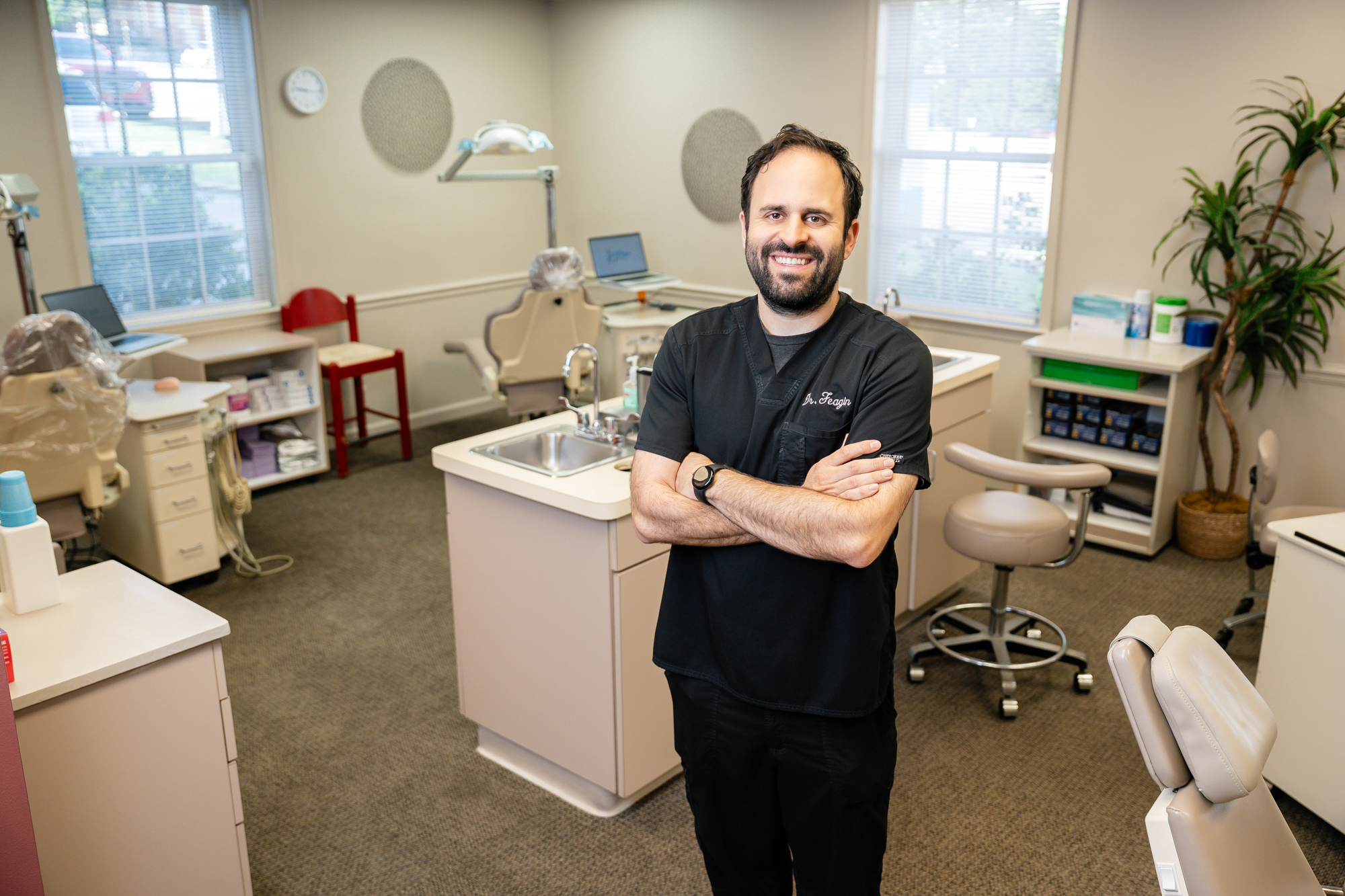
The honest answer is that it depends on your case, which is what an evaluation is for. If aligners are not the right tool, Dr. Kyle Feagin will say so rather than starting a treatment that will not get you where you want to go.
Gum and Bone Health Come First
This is the piece adult patients rarely anticipate and it matters more than almost anything else on this page.
Moving teeth requires healthy bone to move them through and healthy gums holding everything in place. Adults are more likely than teenagers to carry some history here, whether that is past gum disease, recession or bone loss. None of it automatically rules out treatment. It just has to be assessed before anything starts, and in some cases treated first or managed alongside your general dentist.
It is also the clearest argument for being seen in person. A mail-order aligner service working from impressions you took at your kitchen table has no way to evaluate any of this. Attachments, adjustments and the small corrections that keep treatment on track all need someone actually looking at your teeth.
Crowns, Bridges and Implants
Most adults arrive with some dental work already done, and it is one of the first questions people ask.
Crowns move much like natural teeth, though they sometimes need a tooth-coloured attachment bonded on to give the aligner something to grip. Bridges are more restrictive, since the teeth they connect cannot move independently. Implants do not move at all, because they are fused to the bone, so the plan is built around them rather than through them.
None of that rules out treatment. It just means the planning has to account for it from the start, which is why a full set of records at the beginning is worth the extra visit.
Making Room Without Removing Teeth
When teeth are crowded, something has to give. In adults with mild to moderate crowding, the usual answer is interproximal reduction, which sounds far more dramatic than it is. It means polishing a fraction of a millimetre of enamel from between certain teeth to open up the space alignment needs.
It is painless, it does not weaken the teeth and it often removes the need for extractions entirely. For heavier crowding, traditional metal braces or clear braces may give more control, and that is a conversation worth having openly rather than forcing aligners onto a case they do not suit.
Living With Aligners at Work
The practical questions come up more often than the clinical ones.
Aligners are genuinely hard to spot across a conference table or on a video call. The attachments are tooth-coloured and blend in. Most people find that colleagues do not notice unless they mention it.
Speech takes a week or two. There is often a slight lisp at the start and it fades as your tongue adjusts. Reading out loud for a few minutes a day speeds that up noticeably.
The trays come out to eat, which means no food restrictions and no broken brackets, but it also means brushing before they go back in. Lunch at a desk becomes slightly more of a production. Most adults settle into it within a fortnight.
Appointments are the easy part. Once treatment is under way you come in roughly every couple of months, and the visits are short. You can see how that fits alongside the full range of treatments we offer at either office.
The Wear Time Is the Whole Thing
Aligners only work when they are in your mouth. The target is about 22 hours a day, which sounds punishing until you realise it leaves room for three meals and your brushing routine.
This is where adult treatment succeeds or stalls. Nobody is checking up on you the way a parent checks up on a teenager. Trays left in a case on the kitchen counter for an afternoon do not move anything, and enough of those afternoons stretch a six month plan into something considerably longer. If you already know that daily discipline is not your strength, fixed braces may honestly serve you better, and there is no shame in choosing them.
Retainers Are Permanent
Worth saying plainly, because it is the part that undoes the most adult results.
The relapse story at the top of this page is exactly what a retainer prevents. Teeth carry a memory of where they used to sit and they will drift back toward it given the chance. After treatment you will wear a retainer full time briefly, then nightly, and then nightly for good.
Some adults do best with a thin wire bonded behind the lower front teeth combined with a removable upper retainer. Others get on fine with removable retainers on both arches. Either way they wear out eventually and get replaced, and that is normal rather than a sign anything went wrong.
Frequently Asked Questions
Am I too old for clear aligners?
No. There is no upper age limit for orthodontic treatment. What matters is the health of your teeth, gums and supporting bone, all of which are assessed before anything begins. Adults well into their fifties and beyond complete treatment successfully.
How long does clear aligner treatment take for an adult?
Most patients finish in six to eighteen months. Simple cases move faster and cases involving bite correction take longer. You will get a timeline specific to your teeth at your evaluation rather than a general estimate.
Will people notice I am wearing aligners at work?
Usually not. The trays are clear and thin, and any attachments are matched to your tooth colour. Most patients find that colleagues only find out because they mention it.
I had braces as a teenager and my teeth moved. Can clear aligners fix that?
Very often, yes. Post-treatment relapse is one of the most common reasons adults come in, and because the teeth have been aligned before, these cases are frequently among the more straightforward ones. The important part is committing to a retainer afterward.
Can I get clear aligners if I have crowns or implants?
In most cases. Crowns can be moved much like natural teeth, sometimes with the help of an attachment. Implants are fixed in the bone and do not move, so the treatment plan is designed around them. Existing dental work needs to be evaluated properly at the start, which is one reason in-person treatment matters for adults.
Do I have to wear a retainer afterward?
Yes, and indefinitely. Nightly wear is what holds the result. Skipping it is the single most common reason adults end up needing treatment a second time.
Start With an Evaluation
If this has been sitting at the back of your mind for a few years, an evaluation is the low-commitment way to find out where you actually stand. You will get a straight answer on whether clear aligner treatment suits your case, roughly how long it would take and what the alternatives are if it does not.
We see whole families here, so if you have been meaning to book your child’s first orthodontic visit as well, that can happen on the same trip. Visit us at our Homewood office or in Pell City, or schedule a consultation online.