If you have been wondering when to bring your child in for a first orthodontic visit, the answer is earlier than most parents expect. The American Association of Orthodontists recommends a first evaluation by age seven, even when a child’s teeth look perfectly straight.
That surprises a lot of families. It is easy to assume orthodontics is a teenage thing, something you deal with once all the permanent teeth have arrived. The reality is more reassuring than that. An early visit is mostly about information and it rarely ends with anyone getting braces.
Here is what age seven is really about, what you might notice at home and what actually happens when you walk through the door.

Why Age Seven Matters
By around age seven, most children have their first adult molars along with their front permanent teeth. That mix of baby teeth and permanent teeth is exactly what makes the visit useful. It gives an orthodontist enough to work with to see how the bite is coming together and how the jaws are growing, while there is still plenty of growth ahead.
Growth is the key word. Some concerns are far easier to guide while the jaws are still developing than they are to correct once growth has finished. Seeing a child at seven does not start a clock. It simply means nothing gets missed during the years when the options are widest.
What Parents Notice at Home
You do not need to spot anything to book a visit and you certainly do not need to diagnose anything. Still, parents often notice small things and wonder whether they matter.
Watch how your child’s teeth meet when they bite down. If the top and bottom teeth do not seem to make contact, or if the jaw slides to one side to find a comfortable position, that is worth mentioning.
Breathing habits are another one. A child who breathes through their mouth much of the time, especially at night, may be telling you something about how the airway and palate are developing.
Timing tells a story too. Baby teeth usually start loosening around age six. Losing them noticeably early, or holding onto them long after classmates have lost theirs, can affect how the permanent teeth find their place.
Habits that have not faded on their own also belong on the list. Thumb sucking or pacifier use that continues well past the toddler years can gradually change the shape of the palate.
None of these mean something is wrong. They are just useful details to bring with you.
What Happens at Your Child’s First Visit
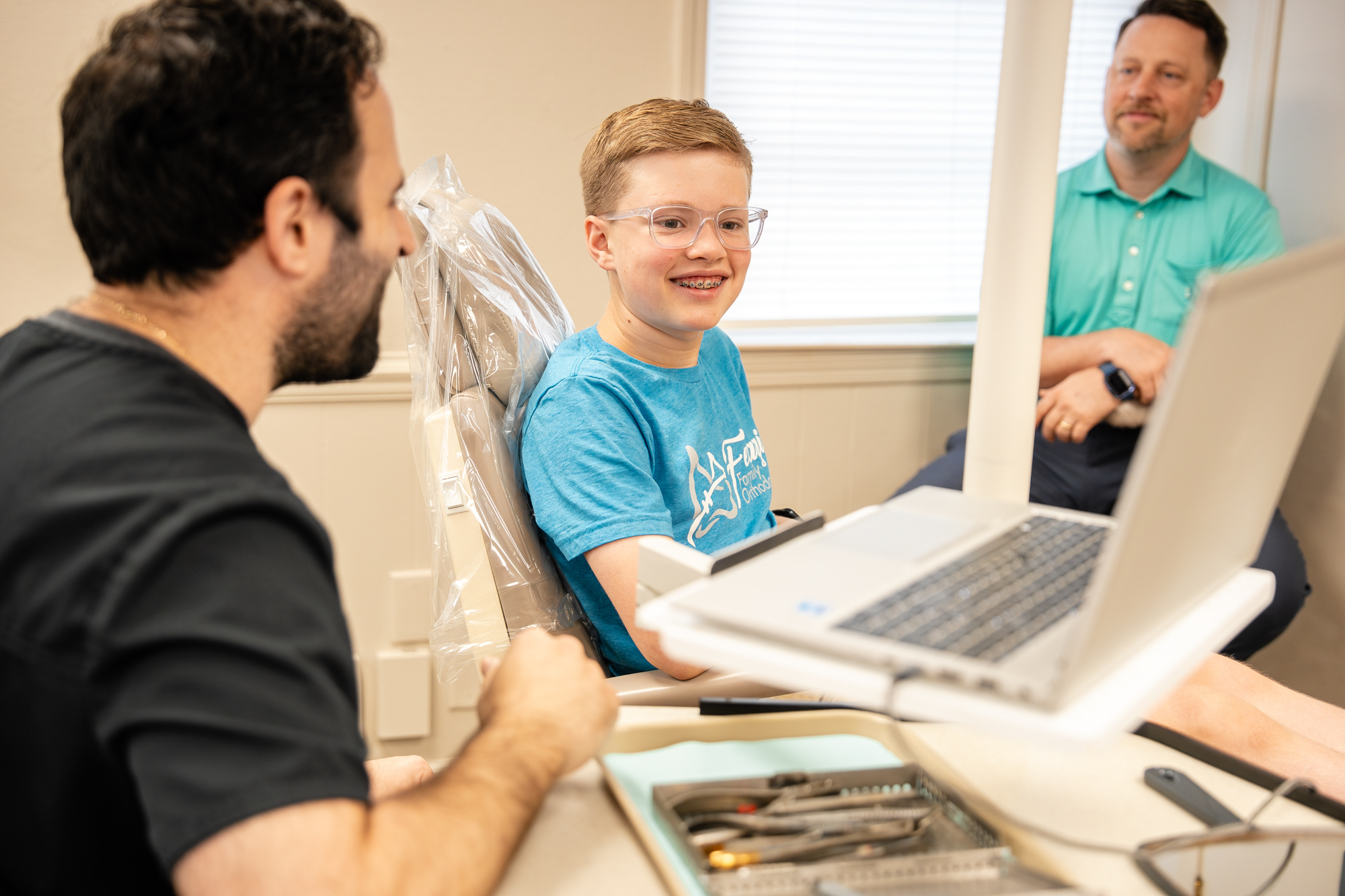
The appointment is calmer than most parents picture. There are no shots, no drilling and nothing that hurts. Here is the usual shape of it.
- Meeting the team. Your child gets a look around and a chance to settle in before anything else happens.
- A conversation. We ask about your child’s dental history, any habits you have noticed and anything that has been on your mind.
- An examination. Dr. Kyle Feagin looks at the teeth, the jaws and the way the upper and lower teeth fit together.
- Digital images if they are needed. These show tooth position, jaw development and where the permanent teeth still under the gums are heading.
- A plain explanation. You hear what was found, whether anything needs attention and whether the answer is treatment now, treatment later or nothing at all.
- Your questions. Bring as many as you like. Nothing is too small to ask.
Most Children Leave Without Treatment
This part is worth repeating. The majority of children who come in around age seven do not need treatment yet, and being told to wait is a real result rather than a wasted trip.
What you get instead is a baseline. We know what your child’s smile looked like at seven, so we can tell whether anything is changing as they grow. Monitoring visits are short and low key, and they mean treatment begins when it will do the most good instead of whenever someone happens to notice a problem.
Dr. Feagin would far rather see a child early and tell you nothing needs doing than meet them at thirteen with a problem that was easier to solve at eight. If you want a fuller picture of how we handle orthodontic care for children and teens, our team is happy to walk you through it.
Phase One and Phase Two, Explained
You may hear these two terms at the visit, so here is what they mean in plain language.
Phase one, sometimes called interceptive treatment, happens roughly between ages six and ten while your child still has a mix of baby and permanent teeth. It is not about straightening every tooth. The goal is to guide jaw growth, address a bite problem or create room for permanent teeth that are running short on space. It often involves a small appliance or a limited round of braces rather than full treatment.
Phase two usually begins once most of the permanent teeth have arrived, generally in the early teen years. This is the phase people picture when they think of orthodontics, and it brings the teeth into their final positions with braces or clear aligners.
Two things worth holding onto. Plenty of children skip phase one entirely and go straight to phase two as teenagers. And phase one is only recommended when acting early genuinely reduces what is needed later. You can see the full range of treatment options we offer at either office.
Helping Your Child Feel Ready
Children take their cues from the adults around them, so a calm tone does most of the work here.
Keep the description simple. Someone is going to count their teeth and take some pictures. That is honest and it is enough.
Say plainly what will not happen. No needles, no drilling, nothing uncomfortable. Kids often arrive with a vague dread borrowed from a dental visit and it helps to clear that up early.
Pick a good time of day. A rested, fed child handles a new place far better than one coming off a long school day.
Jot down your questions beforehand, because it is easy to forget them once you are in the room.
Our Homewood and Pell City offices both see young patients every day, and the team is well used to first-timers.
Frequently Asked Questions
Do my child’s baby teeth need to fall out before an orthodontic visit?
No. Having a mix of baby and permanent teeth is exactly what makes age seven such a useful time to look. It shows how the bite is developing while there is still growth left to guide if anything needs it.
How long does a first orthodontic evaluation take?
Plan for about an hour. That covers the walkthrough, the examination, any images and a full conversation about what we found. You will not be rushed out.
Will my child get braces at the first visit?
Almost certainly not. A first visit is an evaluation, not a treatment appointment. Even when treatment is recommended, it is discussed first and scheduled for another day.
Does my child need a referral from a dentist?
No referral is required. Many families come in on a dentist’s recommendation but you are welcome to schedule an evaluation directly.
What if my child is already older than seven?
Age seven is a starting point, not a deadline. Children of any age benefit from an evaluation, and orthodontic treatment works well for older children, teens and adults alike.
What does it mean if the orthodontist recommends monitoring?
It means nothing needs treatment right now and we want to watch how things develop. Your child comes in periodically so we can track growth and step in at the right moment if it ever becomes worthwhile.
Schedule Your Child’s First Visit
An early orthodontic visit is about information, not commitment. You leave knowing how your child’s smile is developing, what if anything needs attention and when to come back.
If this has been sitting on your to-do list, it is an easy one to check off. Request a consultation and we will take it from there.